

What is a clock?
 Being able to tell and work with time is a very valuable skill. In order to tell time, there are several key points to remember. We measure time in seconds, minutes, hours, days, weeks, months, and years. On a clock, we measure time in hours and minutes (and sometimes seconds). On a calendar, we measure time in days, weeks, months, and years. This section will go through telling time on a clock—using minutes and hours. In order to work with minutes and hours, you must remember that there are 60 seconds in a minute, and 60 minutes in an hour. There are 24 hours in one day.
Parts of a Clock
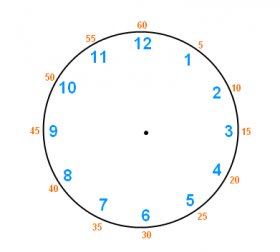
A clock is a device used to tell time. Clocks measure time in hours and minutes, and have an hour hand (that moves forward one clock number every hour) and a minute hand (that moves forward one tick every minute—it moves forward one clock number every 5 minutes). A clock is split up into 12 sections, and each section is worth 5 minutes (because 5 x 12 = 60, and there are 60 minutes in an hour). One complete trip around the clock by the minute hand means that one hour has passed. When you read a clock, you look at the hour hand first, and then you look at the minute hand. The hour hand is shorter, and the minute hand is longer—this is how you tell them apart. A normal clock looks like this:
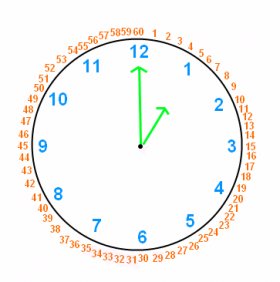
The blue numbers are standard on all clocks—these are clock numbers. You will not see the orange numbers on normal clocks the way they are on the outside of this clock, but these are the minute marks—thus, every 1 clock number is equal to 5 minutes. It can be even further broken down like this:
Now, you can see that the orange numbers on the outside count from 1 to 60. These numbers represent each minute of an hour.
Now, we’ll add in the hour and minute hands. Remember, the hour hand is shorter, and the minute hand is longer. We’re going to set our clock to say 1 o’clock.
Notice that our clock hands have arrows—some clocks have hands with arrows, and others do not. We will show ours with arrows.
Reading a Clock
Reading a clock takes practice, but after you learn how, it’s very easy to do! First, you’re going to locate the hour hand. The hour hand is the shorter of the two clock hands. It moves from one clock number to the next every hour, and it makes one complete rotation around the clock every 12 hours (since there are 12 clock numbers on each clock). Look at which clock number the hour hand is pointing to. That is the number you will use for the hour. Many times, the arrow will not be pointing exactly at the number; in that case, you would look at which number it was at most recently. For example, if the hour hand is half way between the 2 and the 3, you would use 2 as the hour number. The only way you can use a specific number for the hour number is if it has already passed the number in its rotation around the clock. So, even if the hour hand is very close to the 3, you would still say 2 unless the hand has reached, or passed, the 3. Here’s an example of what we mean:
Here, you can see that the hour hand is a little more than half way between the 1 and the 2. Even though it is closer to the 2, we would still say that 1 is our hour number because the hour hand has not passed 2 yet.
RELATED VIDEO

Share this Post
Related posts

Rolex Oyster Perpetual Superlative Chronometer Cosmograph
Ref. 16519, White Gold Cosmograph Daytona Rolex, “Oyster Perpetual, Superlative Chronometer, Officially Certified, Cosmograph…
Read More
Time Keeping devices
If youve ever been to Rome, or seen pictures of this magnificent city, then youll have seen one of the many obelisks that…
Read Morelatest post
-
 Interesting October 4, 2022
 -
 We are supported October 4, 2022
 -
 Useful October 4, 2022
 -
 Sources October 4, 2022
 -
 Our partners September 12, 2022
 -
 Resources September 6, 2022
 -
 How to make a water alarm clock? September 6, 2022
 -
 Mauthe clock History September 6, 2022
 -
 Top 10 Watches Men September 4, 2022