

Modern water clock
Jazari is referring to "an Arabic treatise of unknown date and authorship" that describes a monumental water-clock. It is not listed among Archimedes's works in any ancient sources, and according to Hill, most of it was written by several Arabic authors. The "author" is now referred to as Pseudo-Archimedes. Ridwan al-Saati built Jayrun water clock based on the Pseudo-Archimedes's design. He also mentions some Hormuz, who invented a water clock used by his father in the construction of the Damascus clock:“the design continued in the land of Fars for a long time, and was transmitted from there to the land of the Greeks, and its construction spread out in the land until it was transmitted to Damascus, where it was constructed up to the days of the Byzantines and after that in the days of Banu Umayya, according to what is mentioned in the histories". For details see Hill's Arabic Water Clocks,
It is known that a public water clock was erected in Gaza in fifth century AD, so Hormuz might have lived before the rise of Islam, and possibly re-invented the water clock independently. But simple water clocks were already used by ancient Babylonians and Egyptians. A perfected version, clepsydra ("water thief") is due to Archimedes's contemporary Ctesibius (c.285-222 BC), a renowned engineer, the founder of pneumatics, and possibly the first head of the Alexandrian Museum. Unfortunately, none of his works survived to our times, but his inventions are described by Vitruvius, Athenaeus, Philo of Byzantium, Hero and Proclus. A detailed analysis of Ctesibius's work is given in Russo's Forgotten Revolution.
Some modern engineers credit clepsydra as the first automatic feedback device. The problem Ctesibius faced was that the speed of water escaping a container through a hole depends on the water level in it. To make it work for keeping time he needed a container where the water level remains fixed. This is accomplished by a float with a valve that blocks the inflow when the level rises, and lets it through when it falls, a feedback controller in modern terms. The clock involves three containers, the first one serves as a water reservoir, and empties into the second, which has the float with a valve ensuring that its water level remains constant. So the speed at which it empties into the third container is also constant, and a float in the third container will rise uniformly. A pointer attached to it indicates time. See a nice illustration at Lahanas's site.
RELATED VIDEO



Share this Post
Related posts
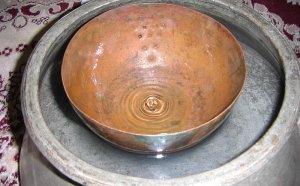
Roman water clock
The Romans first used the sun s movement to measure the passage of time. Using this method they could precisely measure only…
Read More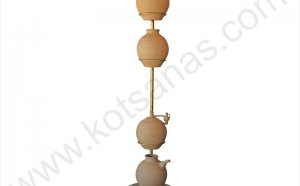
Greek water clock
Today, the ability to keep track of time seems to be taken for granted. One just simply needs to glance at a watch, clock…
Read Morelatest post
-
 Interesting October 4, 2022
 -
 We are supported October 4, 2022
 -
 Useful October 4, 2022
 -
 Sources October 4, 2022
 -
 Our partners September 12, 2022
 -
 Resources September 6, 2022
 -
 How to make a water alarm clock? September 6, 2022
 -
 Mauthe clock History September 6, 2022
 -
 Top 10 Watches Men September 4, 2022